
Software-as-a-Newspaper
Mark Leonard and Ben Thompson referencing the newspaper biz and how that may be a harbinger of times ahead for software

All I want to know is where I’m going to die, so I’ll never go there.”
-Charlie Munger

Interestingly, Munger was also big on newspapers.
Mark Leonard, the CEO, Board Member and Founder of Constellation Software, once opined about when the death of VMS (vertical market software) will come.
Always the student, ML posited this question in the $CSU’s 2017 shareholder letter1:
“To understand the ‘where does it end?’ question, it is useful to look at a much older industry with some similarities to the VMS sector. If Constellation had started in 1895 instead of 1995, we might have had the objective of being a great perpetual owner of daily newspapers.”
ML picked daily newspapers because at the turn of that century, it was experiencing high growth, highly profitable and subject to conglomeration.
ML goes on:
“Many standalone newspaper businesses and newspaper conglomerates did well for extended periods, generating far above average ROE’s. They had deep moats and attracted more than their fair share of intelligent, ethical, driven employees. Some of these businesses returned their FCF to stakeholders, and some deployed it to buy other newspapers. As their industry matured, a few of the newspaper conglomerates acquired somewhat related businesses (book publishing, magazine publishing, radio stations, TV stations, cable franchises, database vendors, etc.). Only a tiny minority of the newspaper conglomerates made the “diversification” transition successfully.”
ML also picked the newspaper industry because we all know how the story ends: newspapers have declined in profitability, in readership, in prominence. And the key thing to remember is that it’s not that newspapers are completely removed from our society and circulation, just greatly reduced and the surviving ones are few and far between.
The question I’d like to know is if ML thinks VMS has reached that peak maturity, consolidation and defensible ROE’s.
Death by a Thousand Distribution Cuts
Ben Thompson has also called out newspapers2 as a lens through which to see the death of Software. What ML didn’t spell out too much above, but perhaps was self-explanatory, is that newspaper economics were defensible cause of geography.
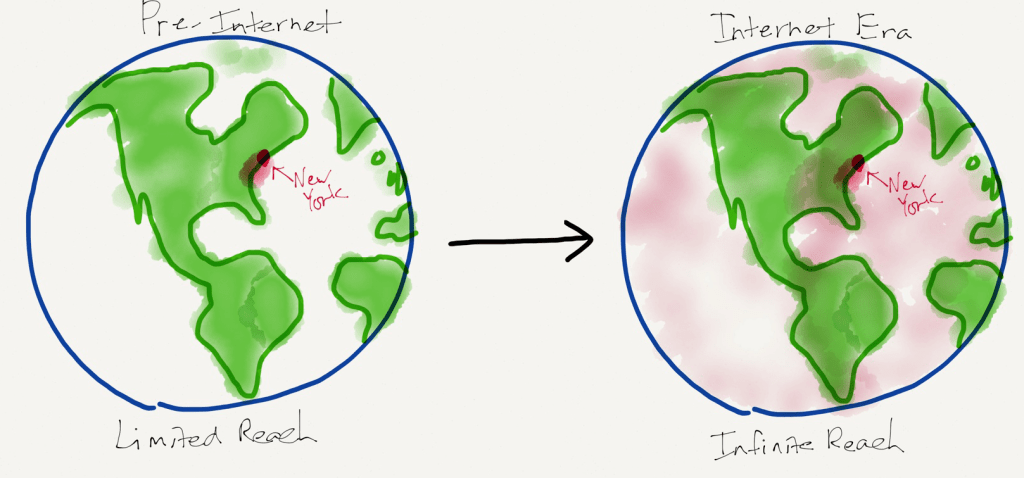
Each region, typically a metropolitan area, has winner-take-all effects because it’s mostly a two-sided marketplace — the two sides being readership and advertisers. So in a way it was a niche over geos versus niche over verticals (for VMS).
So BT of Stratechery, main point in bringing up newspapers versus software is that newspapers were “disrupted” by how removed the barriers to geo. If the content can travel beyond your metro’s borders then it levelled the playing field for any publisher to compete with all other publishers to reach anyone who access to a browser.
BT goes on:
“Specifically, what changed for publishers is that the cost of distribution went to zero: of course that was beneficial for any one publisher, but it was disastrous for publishers as a collective. In the case of software companies, the input that is changing is the cost of code: it’s not going completely to zero, at least not yet — you still need a managing engineer, for one, and tokens, particularly for leading edge models actually capable of writing usable code, have significant marginal costs — but the relative cost is much lower, and the trend is indeed towards zero.
If you want to carry this comparison forward, this is an argument against there even being a market for software in the long run.”3
I don’t know if BT spells this out entirely, at least not to me.
But it is a wonderful thought-experiment about what will happen to the business of software when the primarily input costs are effectively zero. Would one still be able to monetize and sell software? Do we still need “people” to do things or would “agents” do things on their behalf?
Would we still need 3rd party vendors to do anything for an Enterprise?
Here’s My Editorial Note (summary)
Newspapers: When distribution went to zero, the scarcity evaporated and the value shifted to the readers (just look at how much user-generated content we have!!! Just look at how many Substacks you subscribe to alone!)
VMS and Software in-general: When code goes to zero, the scarcity shifts to ???
I don’t have an answer to that question. This is where I think newspapers are limited as an comparison.
I think ML here has a stronger argument because he’s using it at the consolidation industry-level. BT’s argument is a less strong since it’s looking the value-chain-level which is where the comparison breaks down.
ML is saying that newspapers lost a lot of ground. I think VMS will continue to be the same. I think one nail in the coffin is what BT is calling out, that is, code generating and re-generation, is not longer going to cost anything in time, execution and increasingly, maintenance.
Like VMS in 2026, newspapers are not just completely dead businesses decades later, just a fraction of their former selves.
Though at the time ML was worried how he’ll overpay for VMS business, his thinking was very forward thinking, he says in the same letter from 2018:
“… I hope we’ll have had the foresight and luck to find some other high ROE non-VMS businesses in which to invest at attractive prices. I am already casting about for such opportunities. If we don’t find attractive sectors in which to invest, then we’ll return our FCF to our investors. Even if re-investment opportunities become scarcer, Constellation doesn’t end... it will continue to be a good (hopefully great) perpetual owner of its existing VMS portfolio, and will still deploy some capital opportunistically.”
https://www.csisoftware.com/docs/default-source/investor-relations/presidents-letter/presidents-letter-april-2018-final.pdf
https://stratechery.com/2026/microsoft-and-software-survival/#:~:text=When%20the%20Internet,of%20Abundance%3A
https://stratechery.com/2026/microsoft-and-software-survival/#:~:text=Specifically%2C%20what%20changed,the%20long%20run.
One difference, perhaps. Newspapers were also harmed by a surprising willingness of the masses to not care about quality — whether something provided by the newspaper or its newer competitors was true or false. Software has to function correctly. It has to deliver value. So at least that’s a market test on its upstart competitors.